2026 PRICING GUIDE
Are Steel Fence Posts Better Than Wood in Texas Clay? (2026)
By Aesthetic Gates & Fence · Updated · 12 min read
Quick answer
In most cases, yes. In the Blackland clay of Ellis and Navarro County, a galvanized steel post set in concrete avoids the two things that bring wood fences down here: rot at the ground line and termites. Waxahachie and Midlothian require metal posts inside city limits. But steel does not fix a footing that is too shallow or the wrong shape, and thin "residential" pipe is thinner than either city’s minimum.
- Wood posts: Texas A&M AgriLife says subterranean termites are found throughout Texas, and any wood post in the ground should be tagged UC4A or higher (American Wood Protection Association).
- Steel posts: the maker of PostMaster says its galvanized post will not rot, twist or warp or suffer termite damage (a manufacturer claim).
- Wall thickness: on 2-3/8 inch pipe, Wheatland Tube lists 16-gauge at 0.065 in, 13-gauge at 0.095 in and Schedule 40 at 0.154 in.
- Cost per post: Fixr’s national figures put an installed wood post at $10–$50 and a metal post at $10–$60.
Every price on this page is a third-party figure. Aesthetic Gates & Fence has not published prices; Cesar quotes each fence after seeing it, with a free written estimate.
These are published area averages from the sources listed at the end of this guide, not an Aesthetic Gates price list. Cesar quotes every job after seeing it, and the estimate is free.
Are steel fence posts better than wood in Texas clay?
For a wood privacy fence on Blackland clay, galvanized steel posts usually outlast wood posts because they do not rot or feed termites, but the footing matters as much as the post. Titan Fence, a North DFW contractor, says: "Steel posts cost more but improve lifespan over wood posts" (November 2025).
Steel posts, in short
- Do not rot at the soil line and do not feed termites (maker’s claim for PostMaster).
- Some shapes tuck behind the boards, so they are easy to hide (maker claims).
- Cost more per post, and the thin "residential" pipe is below Waxahachie and Midlothian minimums.
Wood posts, in short
- Cheaper per post in Fixr’s national figures.
- Rot and termite damage start where the post meets the soil.
The pickets are a separate choice. For cedar vs pressure-treated pine boards, see cedar vs pine privacy fence in Texas.
What expansive Blackland clay does to a fence post
The clays under Ellis and Navarro County are 40–60% clay with high shrink-swell potential, and in a dry spell they crack up to 3 to 4 inches wide, which loosens whatever is set in them. The clay and crack figures come from the USDA NRCS official soil series descriptions.
- Ellis series: named in Ellis County in 1910, with its type location in Navarro County between Kerens and Bazette on FM-636. Clay throughout, 40–60% clay, cracks 0.5–3 inches wide at 13 inches deep or more.
- Houston Black series: 40–60% clay, dry-season cracks 0.5–4 inches wide reaching 12 inches deep or more, and the cracks stay open 90–150 cumulative days in most years.
- Ferris series: type location about 15 miles west of Corsicana in Navarro County, 40–60% clay, cracks 0.5–3 inches wide in normal years. (This is a soil name, not the city of Ferris.)
A USDA NRCS state soil sheet says Houston Black covers about 1.5 million acres of the Blackland Prairie and that these soils "shrink and swell markedly with changes in moisture content."
A Texas Department of Licensing and Regulation bulletin, written for house foundations, explains that wet expansive soil heaves and dry soil settles. A fence post sits in the same ground.
Johnson Fence, a Texas contractor, says Blackland clay "heaves a shallow post in the first dry summer."
Why wood fence posts fail at the ground line: rot and termites
A wood post fails where it enters the soil, because that is where it stays wet and where termites reach it. Texas A&M AgriLife Extension says subterranean termites are found throughout the state and cause about $500 million in damage in Texas each year.
AgriLife’s guide is written for houses, but it tells homeowners to note any earth-to-wood contact "such as fences" and to remove it or use pressure-treated wood.
If you use wood posts, buy ground-contact lumber. The American Wood Protection Association says posts in the ground need Use Category UC4A or higher, printed on the end tag. The cedar vs pine guide explains how to read that tag.
Fence Advisors, a contractor directory, calls post rot "the primary failure mode" in its Houston section (a directory claim, no method shown).
How long do galvanized steel and wood fence posts last?
No independent study has measured fence post life in Blackland clay, so any exact number is a contractor’s or maker’s claim. What the evidence does show is that untreated wood fails fast, and properly treated wood and galvanized steel last far longer.
In a USDA Forest Products Laboratory test near Saucier, Mississippi, a site rated a "severe" deterioration hazard, 91 treated southern pine posts set in December 1976 had no failures after just over 35 years. Untreated southern pine posts at the same site fail within 2 to 5 years.
- Steel, contractor estimate: Top Rail Fence says a properly installed steel post in Fort Worth clay should last 15 years or more.
- Steel, warranties: Master Halco gives PostMaster a 15-year limited warranty; Gibraltar lists a 30-year warranty on its Z-post. A warranty is not a lifespan.
- Wood fence overall: Fixr says a well-built wood fence lasts about 20 years with routine maintenance (national).
What the galvanizing is
Schedule 40 fence pipe made to ASTM F1083 carries 1.8 ounces of zinc per square foot on the inside and the outside, according to both Wheatland Tube and Merchants Metals. PostMaster is made from G90 galvanized steel, per its maker.
Round pipe, PostMaster or Z-post: which steel post for a wood fence?
Round galvanized pipe uses metal brackets to hold the wood rails, while C-shaped and Z-shaped posts like PostMaster and Gibraltar’s Z-post are made to sit behind the boards. Asked whether its Z-post is stronger than PostMaster, Gibraltar answered: "It is a matter of personal preference, the design of both are very strong."
| Post | Shape | Wind rating claimed | Spacing | Warranty | Source |
|---|---|---|---|---|---|
| PostMaster (Master Halco) | C-shaped, G90 galvanized | 70 mph | 8 ft | 15 years, limited | Master Halco spec; Gibraltar |
| Gibraltar Z-post | Z-shaped, galvanized | 73 mph | 8 ft | 30 years | Gibraltar help center |
| Round 2-3/8 in pipe | Round, rails held with metal brackets | Not stated in these sources | Up to 8 ft in Waxahachie and Midlothian codes | Not stated | Wheatland; city codes |
Master Halco’s 70 mph figure is for a 6 ft privacy fence with posts every 8 feet (1994 Uniform Building Code, exposure B).
Midlothian’s code names round 2-3/8 inch galvanized pipe, and Waxahachie’s checklist asks for metal brackets on the cross members.
17-gauge, 16-gauge, 13-gauge or Schedule 40: galvanized steel post wall thickness
On 2-3/8 inch fence pipe, 17-gauge has a 0.055 inch wall, 16-gauge 0.065, 13-gauge 0.095 and Schedule 40 0.154, according to Wheatland Tube’s pipe table. That means Schedule 40 has about 2.4 times the wall of 16-gauge and weighs about 2.3 times as much per foot.
| Grade | Wall thickness | Weight per foot | Note |
|---|---|---|---|
| 18 gauge | 0.047 in | 1.17 lb | |
| 17 gauge | 0.055 in | 1.36 lb | Labeled "Residential" |
| 16 gauge | 0.065 in | 1.60 lb | Labeled "Residential" |
| 15 gauge (WT-15) | 0.072 in | 1.77 lb | Waxahachie minimum at 6 ft spacing |
| 13 gauge (WT-20) | 0.095 in | 2.31 lb | Waxahachie minimum at 8 ft; Midlothian minimum wall |
| 10 gauge (WT-40) | 0.130 in | 3.12 lb | Same wall as Midlothian’s HOA-district figure |
| Schedule 40 (ASTM F1083) | 0.154 in | 3.65 lb | 1.8 oz/sq ft zinc inside and out |
Merchants Metals lists the same Schedule 40 wall and weight, with a minimum yield of 30,000 psi for regular grade.
Is 16-gauge strong enough?
By the pipe maker’s gauge table, the common 16-gauge (0.065 in) and 17-gauge (0.055 in) pipe is thinner than both Waxahachie minimums (13-gauge at 0.095 in, or 15-gauge at 0.072 in) and thinner than Midlothian’s 0.095 inch minimum. Waxahachie’s checklist states gauge only, not pipe size or shape, so if a contractor proposes a different post, confirm it with the city.
No source here tested how 16-gauge and 17-gauge posts hold up under a wood privacy fence; only wall thickness and weight are documented.
Tip: ask every bidder to write the post’s outside diameter and wall thickness on the quote. "Steel posts" alone could mean any row in the table above.
How deep to set fence posts in clay, and what concrete footing shape
North Texas fence builders set posts about 24 to 36 inches deep in clay, and Midlothian’s code asks for a 30 inch deep, 6 inch wide concrete footing on a 5–7 ft fence. But depth alone does not stop clay from gripping and lifting the concrete.
| Source | Depth | Notes |
|---|---|---|
| Titan Fence (North DFW contractor) | 24–36 in; "typically 30–36 inches" in its FAQ | Clay soils |
| Top Rail Fence (Fort Worth contractor) | At least 2 ft for a 6 ft fence | Deeper in Fort Worth clay |
| This Old House | 36 in for a 6 ft fence | Framed as frost-heave prevention, not clay |
| Midlothian code, 5–7 ft fence | Post 24 in into a 30 in deep footing | 6 in minimum footing diameter; HOA districts: 36 in into 42 in |
| Midlothian code, 7–8 ft fence | Post 32 in into a 42 in deep footing | HOA districts: 36 in into 42 in |
Midlothian’s code also lets the Chief Building Official require more "based upon soil conditions and boring test results."
The general rule from Quikrete
Quikrete’s national post-setting instructions say to dig the hole three times the width of the post, go 1/3 to 1/2 of the above-ground post length plus 6 inches deep, put 6 inches of gravel in the bottom, fill concrete to 3–4 inches below grade and slope the top away from the post. It is a general rule, not written for clay.
Why a deeper plug is not the whole answer
Top Rail Fence says swelling clay can push a concrete collar upward, and shrinking clay opens a gap around it where water pools. Lone Star Fence, a Houston builder working in black gumbo clay, wants "a smooth, vertical cylinder of concrete" so the soil can slide against it, and says a mushroom-shaped footing is what you do not want.
Builders do not all agree on footing shape in expansive clay, and there is no engineering standard for fence footings in this soil to point to. Johnson Fence warns that a shallow post heaves, and Lone Star warns against a mushroom top. Gate posts are a separate job; see gate posts and footings.
Wind: what a 6 ft privacy fence on steel posts has to stand up to
The National Weather Service’s Fort Worth office calls a thunderstorm severe at winds of 58 mph or more, and the two hidden steel posts covered here are rated by their makers for 70 and 73 mph at 8 ft spacing. So post spacing and footing still matter in a North Texas storm.
The NWS Houston/Galveston office says downbursts, often called "straight-line" winds, can gust from 60 mph to over 100 mph. A storm like that can meet or beat the figure a post maker rates its post for.
- Midlothian: posts max 8 ft apart on 5–7 ft fences, and max 6 ft apart on 7–8 ft fences.
- Waxahachie: 13-gauge posts may go up to 8 ft apart; 15-gauge posts only up to 6 ft apart.
- Titan Fence: steel posts plus airflow between boards reduce blow-over risk.
What steel fence posts cost compared with wood
Fixr’s national figures put an installed wood post at $10–$50 and an installed metal post at $10–$60. Fence Advisors puts DFW cedar on metal posts at $38–$55 per foot, about $5–$10 a foot more than a standard build.
| Item | Price | Source |
|---|---|---|
| Wood post, installed | $10–$50 (materials $5–$20) | Fixr, Jan 2025 |
| Metal post, installed | $10–$60 (materials $5–$30) | Fixr, Jan 2025 |
| 16-gauge 2-3/8 in post, 6 ft, 0.065 in wall | $17.98 each, material only | ChainLinkFittings.com, 2026 |
| 13-gauge 2-3/8 in post, 8 ft, 0.095 in wall | $29.67 each, material only | American Fence & Supply, 2026 |
| Resecure a loose post | $80–$100 per post | Fixr, Jan 2025 |
| Repair or replace a broken metal post | $120–$400 per post | Fixr, Jan 2025 |
The two retail posts are online store prices for material only, not installed prices.
For per-foot prices and totals by fence length, see privacy fence cost in Corsicana and privacy fence cost in Waxahachie.
Fence post rules in Midlothian, Waxahachie, Ennis and Red Oak
Midlothian requires galvanized steel posts at least 2-3/8 inch by 0.095 inch and bans pine pickets, Waxahachie requires metal posts on privacy fences, and Ennis and Red Oak do not set a post material in the pages checked. These rules apply inside city limits only.
- Midlothian (Zoning Ordinance §3.5221): "All vertical posts shall be a minimum 2-3/8 inch outside diameter by .095 (Schedule 20) galvanized steel" with a galvanized cap, and in HOA-maintained Planned Developments "0.130 (Schedule 40)". Pine pickets and planks, treated or untreated, are prohibited. The bottom of the fence may not touch the ground, with a gap of no more than 4 inches.
- Waxahachie (fence permit checklist, rev. 05/24): privacy fences need "a minimum 13-gauge metal support post installed at a maximum of every 8 feet," or minimum 15-gauge at most every 6 feet, with metal caps and metal brackets for the cross members. The city says the checklist is not all-inclusive.
- Ennis (UDO 7.3.4): vinyl and sheet metal privacy fences are prohibited in R-10, R-5 and similar districts. No post-material rule was found there.
- Red Oak: fences may be wood, masonry, wrought iron, wire or other compatible materials, up to 8 ft. A permit is needed for a new fence or "replacing more than 25% of the pickets." Nothing on post material.
For permits, fees, heights and corner lots, see fence permit rules in Ellis County. Town pages: privacy fence in Midlothian, wood fence in Midlothian, privacy fence in Waxahachie, wood fence in Waxahachie, privacy fence in Ennis and fence work in Ennis.
Replacing rotted wood fence posts with steel
If the pickets and rails are still sound, rotted wood posts can be swapped for steel, and Fixr puts repairing or replacing a metal fence post at $120–$400 per post nationally. Resecuring a loose post runs $80–$100 per post in the same survey.
- Red Oak: replacing more than 25% of the pickets needs a permit.
- Waxahachie: a privacy fence built under the permit checklist needs metal posts, metal caps and metal brackets.
- Midlothian: the code sets the post spec above. The pages checked do not say whether it applies to a partial repair, so check with the city before you start.
More on leaning and rotted posts: fence repair in Corsicana.
So which fence posts should you choose?
For most wood privacy fences in Ellis and Navarro County, galvanized steel posts in a well-shaped concrete footing are the safer choice.
- Inside Waxahachie or Midlothian: metal posts by code, at the city’s minimum or heavier.
- Elsewhere on Blackland clay: galvanized steel at 13-gauge (0.095 in wall) or heavier, set in a smooth, straight concrete footing deep enough for the clay.
- If you choose wood: posts tagged UC4A or better.
Aesthetic Gates & Fence builds wood privacy fence across Corsicana, Navarro County and Ellis County. Cesar will look at your fence line and give you a free written estimate. See finished fences or ask for an estimate.
FAQs
THE SERVICE
Privacy Fence from Aesthetic Gates
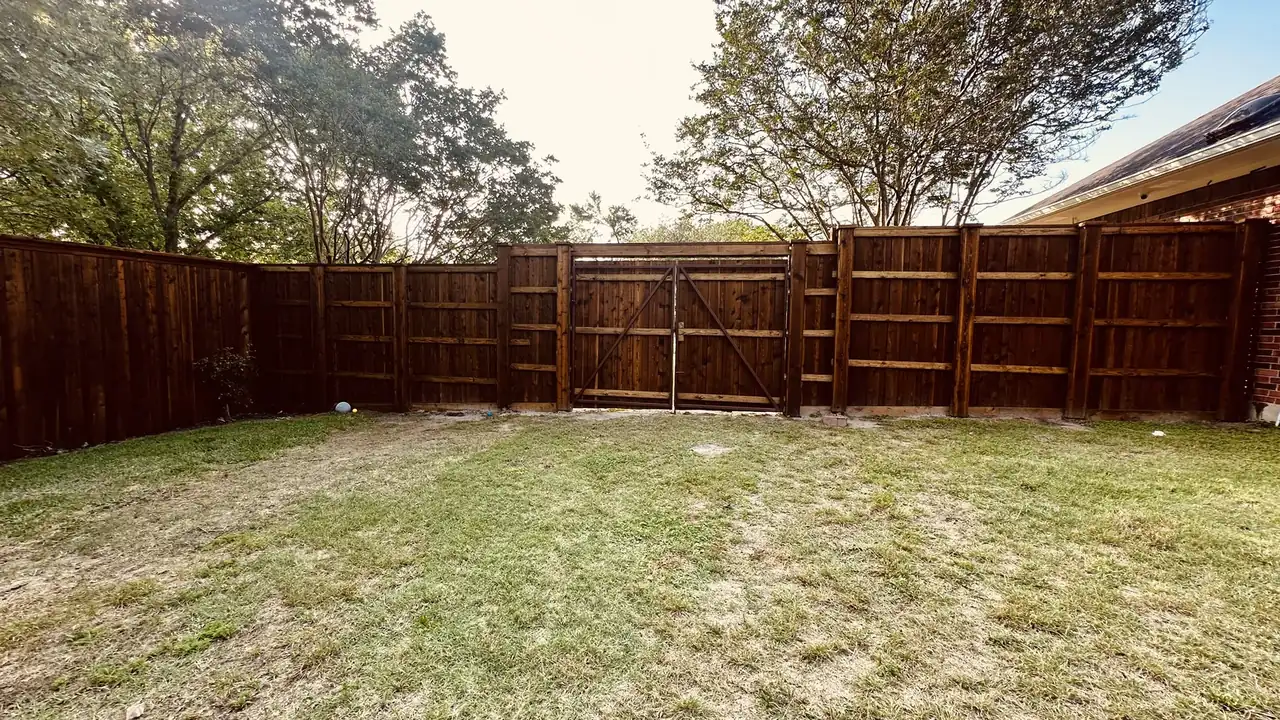
Cedar and wood privacy fence built on posts set in concrete, with the pickets and rails matched to what is already on the property.
Sources
- USDA NRCS: Ellis Soil Series: Official Series Description, rev. 03/2001; clay content, shrink-swell, crack width, type location
- USDA NRCS: Houston Black Soil Series: Official Series Description, rev. 08/2017; clay content, crack width, days open
- USDA NRCS: Ferris Soil Series: Official Series Description, rev. 08/2017; type location near Corsicana
- USDA NRCS Texas state soil sheet (hosted by TWDB): undated (file 2002); Houston Black acreage and shrink-swell
- TDLR Technical Bulletin TB 10-01: Texas Department of Licensing and Regulation, Jan 7, 2010, rev. Oct 16, 2018; expansive soil movement (foundations)
- Johnson Fence: How Deep a Fence Post Goes in Texas Soil: Tomball TX contractor, undated (2026); shallow post heave
- Titan Fence: Wood Fence Cost: North DFW contractor, Nov 28, 2025; post depth in clay, steel posts, wind
- Top Rail Fence: Fence Post Leaning in Fort Worth? Here Is Why: Fort Worth contractor, May 21, 2026; concrete collar heave, steel post life estimate
- Lone Star Fence & Construction: Black Soil and Your Fence: Houston contractor, undated (2026); footing shape in gumbo clay
- AWPA Residential Infographic: American Wood Protection Association, 2021; UC4A for posts, end tag
- USDA FPL: CCA-Treated Posts After 35 Years (Woodward, Kirker, Lebow): via Southern Pressure Treaters’ Association, Fall 2012; treated vs untreated post life
- U.S. EPA: Chromated Arsenicals (CCA): undated; homeowner-use CCA discontinued December 2003
- Texas A&M AgriLife Extension E-368: Subterranean Termites: Gold, Schofield, Brown, Keck, 2010; statewide range, Texas damage, fences and soil contact
- Fence Advisors: Fence Cost in Texas 2026: contractor directory, Mar 22, 2026; post rot, metal post premium, DFW per-foot prices
- Master Halco PostMaster steel post spec (via Sweets): manufacturer claims, undated; G90, 70 mph, 15-year warranty, concealment
- Gibraltar Building Products: Z-post vs PostMaster: manufacturer help center, undated; wind ratings, warranties, concealment
- Wheatland Tube: Fence Framework Size and Dimensions Tables: pipe manufacturer, WFE-040226, 2026; wall thickness and weight by gauge
- Merchants Metals Spec Tech: Schedule 40 Galvanized Pipe: rev. April 2021; Schedule 40 dimensions, zinc coating, maintenance
- American Fence & Supply: 2-3/8 in x 8 ft, 0.095 in wall post: online fence supplier with Georgetown and League City stores, 2026; material price only
- ChainLinkFittings.com (DF Supply): 2-3/8 in x 6 ft, 0.065 in wall post: online fence supplier, 2026; material price only
- City of Midlothian Zoning Ordinance, Chapter 3 (via Zoneomics): §3.5221; Ord. 2013-24, 2018-43, 2018-51; post size, footing depth, spacing, pine pickets
- City of Waxahachie: Fence Permit Submittal Guide: rev. 05/24; metal post gauge and spacing, brackets, caps
- City of Ennis UDO, Chapter 7 (via Zoneomics): undated; 7.3.4 residential fence materials, exposed posts facing away from street
- City of Red Oak: Residential Building Permit: undated; fence materials, height, 25% picket permit rule
- QUIKRETE: Setting Posts: undated; general national post-setting method
- This Old House: Fence Post Installation: updated May 22, 2026; 36 in depth for a 6 ft fence
- National Weather Service Fort Worth: Storm Spotter’s Dictionary: undated; severe thunderstorm definition, 58 mph
- National Weather Service Houston/Galveston: Thunderstorm Awareness: undated; straight-line wind gusts 60 to over 100 mph
- Fixr: Wood Fence Cost: national, updated Jan 31, 2025; wood vs metal post installed cost, wood fence life
- Fixr: Aluminum and Steel Fence Repair Cost: national, updated Jan 31, 2025; resecure and replace post costs
More cost guides
- How Much Does a Welded Steel Patio Cover Cost in Ellis County, Texas? (2026)
- How Much Does Fence Repair Cost in Waxahachie and Ellis County? (2026)
- Gate Opener Not Working? Repair or Replace in Waxahachie (2026)
- How Much Does a Custom Driveway Gate Cost in Red Oak, TX? Styles and Prices (2026)
- Privacy Fence Installation Cost per Linear Foot in Midlothian, TX (2026)
- Best Solar Gate Openers for Heavy Ranch Gates in Texas: Solar or Wired? (2026)
- Cedar vs Pressure-Treated Pine Fence in Texas: Which Lasts Longer? (2026)
- Best Fence and Gate Companies in Ellis County, TX (2026)
- How Much Does a Ranch Entrance with a Pipe Gate Cost in Navarro County, Texas? (2026)
- Do You Need a Fence Permit in Waxahachie, TX? Permit Requirements and Fence Height Rules for Ellis County (2026)
- Wood Privacy Fence Installation Cost per Linear Foot in Waxahachie, TX (2026)
- How Much Does Automatic Driveway Gate Installation Cost in Midlothian and Ellis County, TX? (2026)
- How Much Does a Welded Metal Carport Cost in Ellis and Navarro County, TX? (2026)
- How Much Does a Driveway Gate Cost in Corsicana, TX? (2026)
- How Much Does an Automatic Gate Opener Cost in Corsicana, TX? (2026)
- How Much Does a Privacy Fence Cost in Corsicana, TX? (2026)
- How Much Does a Wrought Iron Fence Cost in Corsicana, TX? (2026)
- How Much Does Pipe Fence Cost in Texas? (2026): Pipe & Ranch Rail Fence Pricing for Navarro County
CORSICANA, TEXAS · 32.0954° N, 96.4689° W
GET YOUR OWN NUMBER.
Averages only go so far. Send a few photos and the address, and Cesar will come look at it and give you a straight number, free.