2026 PRICING GUIDE
How Much Does a Wrought Iron Fence Cost in Corsicana, TX? (2026)
By Aesthetic Gates & Fence · Updated · 10 min read
Quick answer
A wrought iron fence in Corsicana typically costs somewhere between $50 and $85 per linear foot installed by national survey data, with Dallas–Fort Worth averages landing around $3,200 for a typical residential job.
- National installed range: HomeGuide puts iron fence at $50–$85 per linear foot installed, from $40–$50 for 3-foot fence up to $75–$85 for 6-foot.
- Dallas average: Angi’s 2026 Dallas page lists an average job of about $3,201, with most between $1,452 and $5,053.
- 100 linear feet: HomeGuide’s national figure is $5,000–$8,500; Angi’s Dallas sample for 4-foot fence is $2,525–$3,550.
- 200 linear feet: HomeGuide puts it at $10,000–$17,000 nationally.
- Custom welded panels: HomeGuide lists custom ornamental work at $85–$130 per linear foot.
- Gates are extra: a single-car driveway gate runs $4,000–$6,000 installed per HomeGuide; Angi lists gates from $600 manual to $8,500 automated.
For most Navarro and Ellis County homes, that means a front-yard or pool run usually lands in four figures and a full 200-foot perimeter with a drive gate lands well into five, and height plus gate count move it more than anything else. Aesthetic Gates has not published prices; every number here is a third-party average, and Aesthetic Gates quotes each job in writing, free, after seeing it.
These are published area averages from the sources listed at the end of this guide, not an Aesthetic Gates price list. Cesar quotes every job after seeing it, and the estimate is free.
What actually drives the cost of an iron fence
Five things set the price of an iron fence: how tall it is, how much ornament is on it, how long the run is, how many gates it has, and what is in the ground where it goes. Paint color and brand matter far less.
1. Height
Height is the single biggest per-foot driver. HomeGuide’s national figures climb from $40–$50 per linear foot at 3 feet to $50–$65 at 4 feet, $65–$75 at 5 feet and $75–$85 at 6 feet, because taller fence needs heavier pickets, more rail and deeper posts. A 4-foot fence across the front of a house and a 6-foot security run are different jobs, not the same job with taller pickets.
2. Style and ornament
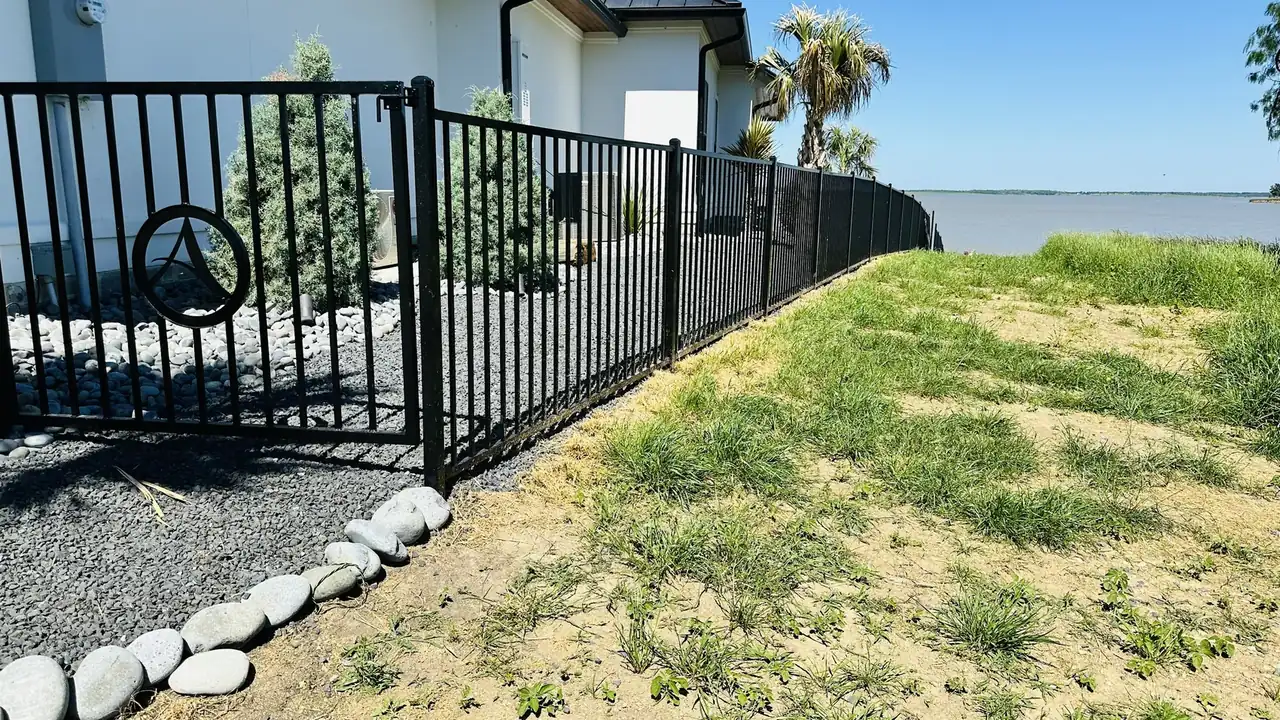
Plain pickets cost the least; finials, scrolls, rings and arched tops add welding time. HomeGuide puts plain black iron at $50–$60 per linear foot installed and ornamental at $65–$85, with custom ornamental work at $85–$130.
3. Length of the run
Total cost scales with footage, but not perfectly. Setup, travel and the gate are fixed costs, so a 60-foot pool run costs more per foot than a 300-foot perimeter. Measure your line before you call anyone so every quote is priced on the same footage.
4. Gates
Gates are where a fence budget gets away from people. A walk gate is a small line item; a driveway gate, the columns it hangs on, and an automatic opener can cost as much as the fence itself. See the gate section below for published numbers.
5. Ground, grade and access
Blackland Prairie clay, slopes, tree roots and old fence that has to come out all add labor. A run that follows a grade has to be racked or stepped, and a lot with no truck access means hand-carrying every panel and every bag of concrete.
Iron fence cost breakdown by component
Most of an iron fence quote is the fence itself; the rest is gates, prep and paperwork. These are published third-party ranges, labelled by where they come from, so you can see what each line on a quote should roughly look like.
| Component | Published range | Source / basis |
|---|---|---|
| Installed fence, 4–6 ft | $50–$85 per linear foot | HomeGuide, national, installed |
| Installation labor only | $15–$25 per linear foot | HomeGuide, national |
| Fence materials, 4 ft (Dallas) | $25.25–$35.50 per linear foot | Angi Dallas, materials |
| Installer labor (Dallas) | $35–$95 per hour | Angi Dallas |
| Old fence removal | $3–$5 per linear foot | Angi, national |
| Property survey (Dallas) | $300–$700 | Angi Dallas |
| Brick or masonry column | $450–$1,275 each | Angi, national |
| Painting an existing iron fence | $5–$12 per linear foot | HomeGuide, national |
True wrought iron vs ornamental steel vs aluminum vs custom welded panels
Almost every “wrought iron fence” sold today is actually welded steel, and the real choice for most homeowners is between plain steel panels, galvanized steel, aluminum, and custom panels welded to the job. Here is how they compare on published price.
| Option | Published range per linear foot | Notes |
|---|---|---|
| True wrought iron (hand-forged) | No reliable published range | Rarely made new; mostly restoration, quoted per job |
| Plain black steel (“wrought iron”) | $50–$60 installed | HomeGuide; the common residential fence |
| Galvanized steel | $60–$65 installed | HomeGuide; zinc layer under the finish |
| Ornamental steel | $65–$85 installed | HomeGuide; finials, scrolls, arched tops |
| Aluminum | $25–$75 | HomeGuide comparison; lighter, will not rust |
| Custom welded-in-shop panels | $85–$130 installed | HomeGuide “custom ornamental” |
True wrought iron
Real wrought iron is a low-carbon iron worked by hand, and almost nobody makes new fence from it any more. If you own a historic fence, repair and restoration is quoted job by job; for a new fence, you are choosing among the steel and aluminum options below.
Ornamental steel
Welded steel is what nearly everyone means by wrought iron fence today, and it is stronger than the original material. It is heavy, rigid and hard to bend or climb, which is why it suits pool enclosures and front elevations. Its weakness is rust wherever the finish is broken.
Aluminum
Aluminum looks similar from the street, does not rust, and comes in pre-made panels. Fixr’s national figures put 100 feet of 4-foot aluminum at an average of about $7,150. It is lighter and easier to bend than steel, which matters for a fence that has to stop livestock or take a hit from a mower.
Custom panels welded in the shop
Custom panels are built to your exact opening, picket spacing and grade rather than cut down from a stock size. HomeGuide puts custom ornamental work at $85–$130 per linear foot. Welded joints do not loosen the way bracket-and-screw kit panels can, which is the reason to pay for it. Aesthetic Gates builds its wrought iron fence panels welded in its own shop and quotes them after measuring the job.
Powder coat vs paint
The finish decides how soon an iron fence starts to rust, and both factory powder coat and shop paint can work if the steel is prepared properly underneath.
- Powder coat is baked on at the factory or a coating shop. It is tough and even, but a scratch that reaches bare steel still needs touching up, and recoating a whole panel means taking it down. Fixr lists powder-coated aluminum fence at $13–$45 per foot in materials.
- Primer and paint is what most welded fence gets, because it can be applied after welding and touched up in place. Repainting later runs $5–$12 per linear foot by HomeGuide’s figures, mostly in scraping and priming rust.
- Galvanizing adds a zinc layer under the finish; HomeGuide puts galvanized steel fence at $60–$65 per linear foot installed versus $50–$60 for plain black.
Whichever finish you choose, ask what is done to the welds, the cut ends and the inside of the posts. Rust nearly always starts at a weld or a post cap, not in the middle of a picket.
Iron fence cost by project size
Footage is the easiest way to sanity-check a quote. Using HomeGuide’s national installed range of $50–$85 per linear foot and Angi’s Dallas sample costs, here is roughly where common jobs land before gates.
Front elevation or small pool run — about 50–75 feet
Angi’s Dallas sample puts 50 feet of 4-foot fence at $1,260–$1,775; at HomeGuide’s installed rates the same 50 feet works out to roughly $2,500–$4,250. Expect the per-foot price to sit at the high end on short runs, because setup is a fixed cost.
Typical backyard or pool enclosure — about 100 feet
HomeGuide lists 100 feet at $5,000–$8,500 nationally; Angi’s Dallas sample for 4-foot fence is $2,525–$3,550. The gap is mostly height, ornament and whether the figure is installed.
Half-acre perimeter or lake lot — about 200 feet
HomeGuide puts 200 feet at $10,000–$17,000, and 150 feet at $7,500–$12,750. Gates are on top of that.
Acreage frontage — 300 feet and up
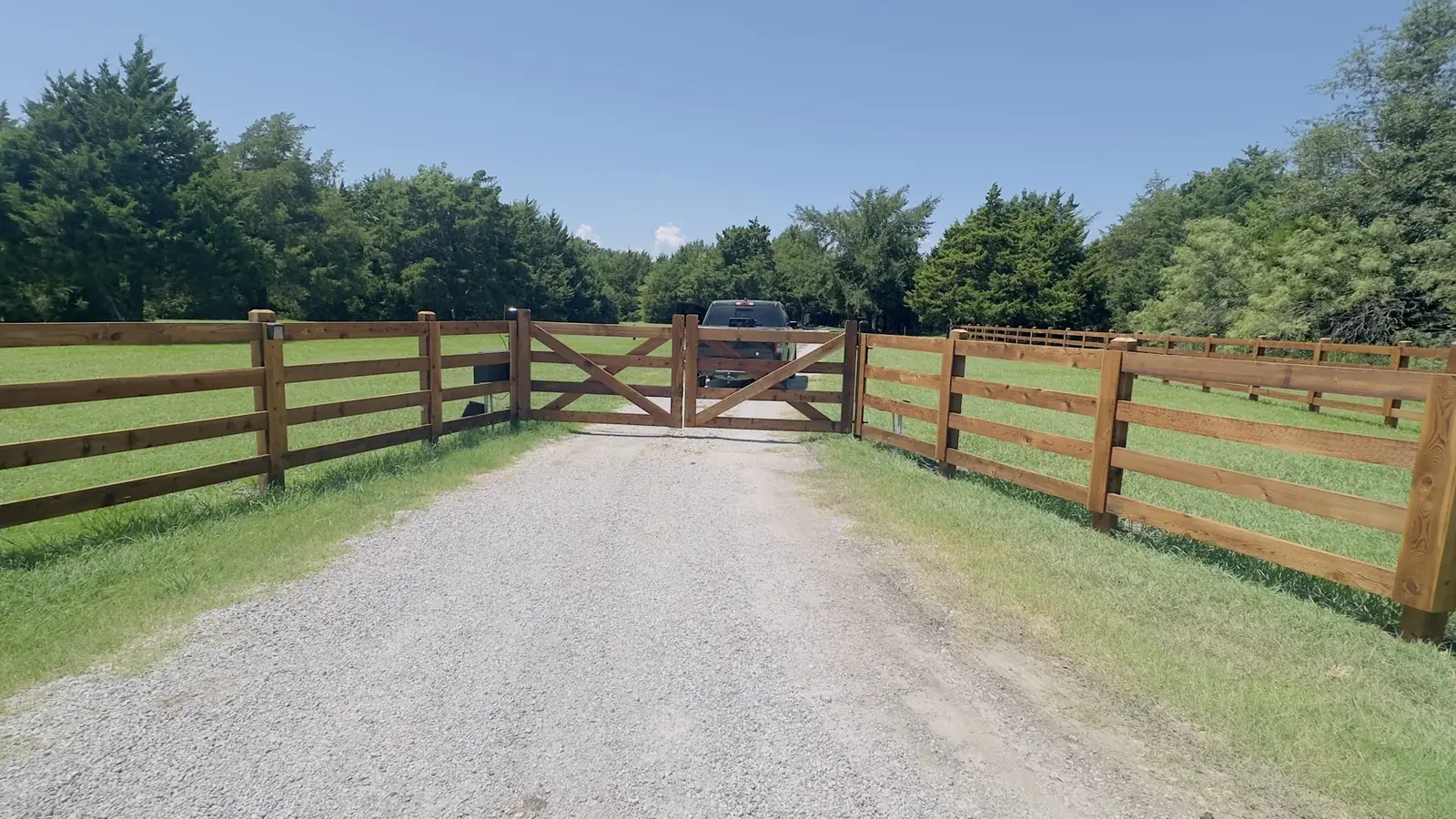
HomeGuide lists 300 feet at $15,000–$25,500 and 400 feet at $20,000–$34,000. On acreage, many owners run iron only across the front and near the house and switch to pipe and ranch rail for the pasture side.
Adding walk gates and drive gates
A walk gate adds hundreds of dollars to an iron fence; a driveway gate adds thousands, and an automatic one adds more again.
| Gate | Published range | Source |
|---|---|---|
| Iron gate, materials only | $200–$650 | HomeGuide, national |
| Walk-through gate | from about $300 | Bob Vila, national |
| Simple gate (DFW) | around $600 | DFW Fence Contractor, 2025 |
| Single-car driveway gate, installed | $4,000–$6,000 | HomeGuide, national |
| Swing gate 10 ft and wider, installed | $6,500–$9,000 | HomeGuide, national |
| Wrought iron driveway gate with bollards | $3,000–$6,000 | Fixr, national |
| Gate range, manual to automated | $600–$8,500 | Angi, national |
Build the gates with the fence when you can: matching picket spacing and finish is far easier when both come out of the same shop, and the gate posts can be sized for the gate’s weight from the start. See custom gates (also in Waxahachie) for what goes into a drive gate.
Pool-code fencing
If the fence encloses a pool, it is a safety barrier first and a fence second, and the rules — not the look — set the minimum spec.
- Height: pool barriers are generally required to be at least 48 inches tall; Fixr notes pool fence panels must stand 48 inches or taller.
- Picket spacing: gaps narrow enough that a small child cannot pass through, and no horizontal rails placed where they form a ladder on the outside.
- Gates: self-closing and self-latching, opening away from the pool, with the latch out of a child’s reach.
- Check locally: confirm the current barrier requirements with the City of Corsicana (or your city, or your HOA) before you sign, and ask your installer to build to them.
A 4-foot pool fence sits in HomeGuide’s $50–$65 per linear foot band. The self-closing gate hardware is the line item most often missing from a cheap pool quote.
Local factors in Corsicana, Ennis and Waxahachie
North Central Texas adds a few costs that national averages do not show, and nearly all of them are about the posts and the finish.
- Blackland Prairie clay: the soil across Navarro and Ellis County swells in a wet winter and shrinks in a dry August. Posts set shallow or without enough concrete get pushed out of plumb, and on a rigid welded fence that shows as racked panels and gates that drag.
- Wind and storms: iron fence lets wind through, which is one of its advantages over solid privacy fence, but gates and tall runs still need posts sized for their load.
- Lakefront and waterfront rust: lots on Richland-Chambers, Navarro Mills or Lake Halbert see more moisture, and sprinkler spray does the same in town. Plan for galvanized steel or aluminum near water, and for touching up scratches every year.
- HOA rules: newer subdivisions around Corsicana, Ennis and Waxahachie often specify height, color and picket style. Get the HOA approval in writing before ordering panels.
- Property lines: Angi’s Dallas page puts a survey at $300–$700. On an older lot or acreage with no clear pins, that is cheaper than moving a fence.
- Call Texas811 before digging: it is free, and every post hole needs utility lines marked first.
Aesthetic Gates builds iron fence across Navarro County and up I-45 — see the Ennis and Waxahachie iron fence pages for those areas.
The 20–30-year view: iron vs wood
Iron costs more up front than wood and usually less over 25 years, because a wood fence is commonly rebuilt within that time and an iron fence is repainted.
- Wood: Fixr lists wood privacy fence at $17–$37 per linear foot installed, says pressure-treated pine typically lasts 10–15 years and a well-maintained quality wood fence about 20, and puts painting or staining an average fence at around $1,500.
- Iron: HomeGuide puts iron at $50–$85 per linear foot installed with a lifespan of 50–100 years when maintained; repainting runs $5–$12 per linear foot.
- Over 200 feet: wood privacy fence works out to roughly $3,400–$7,400 to install by Fixr’s figures, and over 25 years a pine fence may need one full rebuild plus periodic staining. Iron at HomeGuide’s rates is $10,000–$17,000 up front, plus a repaint or two at roughly $1,000–$2,400 each.
Iron and wood do different jobs, though: iron defines the property and keeps the view, wood gives privacy. Plenty of properties use both — iron across the front, cedar privacy fence down the sides and back.
Mistakes that cost homeowners money
Most expensive iron fence problems come from decisions made before the first post goes in.
1. Hiring on price alone
The cheapest quote is often the shallowest posts, the thinnest pickets or a bolted kit panel. On clay soil, a fence that leans in three years costs more than the difference between the two bids.
2. Comparing different fences
A 4-foot plain fence and a 5-foot ornamental fence are different prices for good reason. Give every contractor the same height, style and footage.
3. Leaving the gates for later
Adding a drive gate after the fence is up often means replacing the end posts, because they were never sized for a gate’s weight.
4. Ignoring the finish near water or sprinklers
Plain steel next to a lake or under a sprinkler head rusts first. Pay for galvanizing or aluminum where the fence stays wet.
5. Skipping the survey or HOA approval
A fence built a foot over the line or in the wrong style for the HOA can have to come out. Both checks cost far less than a rebuild.
How to compare iron fence quotes
A real iron fence quote spells out the fence, the posts, the gates and the finish in writing, so you can line bids up side by side.
- Total linear footage and height.
- Picket size and spacing, rail count, and post size.
- Welded panels or bracket-and-screw kit panels.
- Post depth and footing — concrete, and how deep.
- Finish: primer and paint, powder coat or galvanized, and what is done to welds and cut ends.
- Each gate listed separately: size, hinges, latch, and whether an opener is included.
- Removal of old fence, haul-off, and who handles the survey, permits and Texas811 call.
- Payment schedule and what happens if rock or an unmarked line is hit.
Aesthetic Gates does not publish prices; it quotes each job after seeing it, with a free written estimate. Look at our work for iron fence and gates it has built, then request an estimate. If you also need rail along steps or a porch, ask about handrails at the same visit.
FAQs
THE SERVICE
Wrought Iron Fence from Aesthetic Gates
Wrought iron fence and panels welded in our shop — the look of the property without closing off the view.
Sources
- HomeGuide — How Much Does a Wrought Iron Fence Cost? (2026) — national installed per-foot, height, type, length totals, gates, painting, lifespan, fence comparison
- Angi — Wrought Iron Fence Cost in Dallas, TX — Dallas averages, materials per foot, sample lengths, survey, permits, labor; February 2026
- Angi — How Much Does Wrought Iron Fence Installation Cost? — national gates, columns, removal; 2026
- Fixr — Aluminum Fence Cost — national aluminum totals, powder coat, pool fence height; updated August 2025
- Fixr — Metal Fence Installation Cost — national wrought iron driveway gate with bollards; updated January 2025
- Fixr — Wood Fence Cost — national wood privacy fence per foot, lifespan, staining; updated January 2025
- Bob Vila — Wrought-Iron Fence Cost — national walk-through gate figure
- DFW Fence Contractor — 2025 Wrought Iron Fence Costs — Dallas–Fort Worth contractor guide, simple gate figure; March 2025
More cost guides
CORSICANA, TEXAS — 32.0954° N, 96.4689° W
GET YOUR OWN NUMBER.
Averages only go so far. Send a few photos and the address, and Cesar will come look at it and give you a straight number — free.