2026 PRICING GUIDE
How Much Does Pipe Fence Cost in Texas? (2026) — Pipe & Ranch Rail Fence Pricing for Navarro County
By Aesthetic Gates & Fence · Updated · 11 min read
Quick answer
Installed pipe fence costs about $13.50–$40 per linear foot in published national cost surveys, and those same surveys put rural Texas near the bottom of that range, at about $13.50 a foot.
- One acre (835 ft of perimeter): about $11,300–$33,400 at that per-foot range.
- Five acres (about 1,870 ft): roughly $25,200–$74,700.
- Ten acres (2,640 ft): roughly $35,600–$105,600.
- Twenty acres (about 3,730 ft): roughly $50,400–$149,400.
- Wood split-rail ranch fence: about $15–$35 per linear foot installed nationally, by species and rail count.
- Livestock gates: about $160–$800 each; an installed driveway gate averages $1,000–$6,000 nationally.
Most acreage owners around Corsicana are fencing the road frontage first, which is a few hundred feet and a few thousand to the low tens of thousands of dollars, not the whole perimeter. The biggest swing in price is length, then how many rails and whether wire goes on it. These are third-party averages: Aesthetic Gates has not published prices and quotes each job after walking the line, with a free written estimate.
These are published area averages from the sources listed at the end of this guide, not an Aesthetic Gates price list. Cesar quotes every job after seeing it, and the estimate is free.
What actually drives the cost of pipe fence
Five things set the price of a pipe fence: total length, the number of rails, whether wire goes on it, how the posts are set, and how many corners and gates the line has. Length matters most because every other cost is multiplied by it.
1. Length of the run
Pipe fence is priced by the linear foot, so the length of the line is the single largest number in the quote. Published surveys put installed pipe fence at $13.50–$40 per linear foot, which means every 100 feet adds roughly $1,350–$4,000. That is why a front-only run along the road costs a fraction of a full perimeter.
2. Number of rails
Each extra rail adds a full run of pipe along the whole fence, plus a weld at every post. Going from two rails to three adds 50% more rail pipe; going to four doubles it. Posts, digging and concrete stay roughly the same, so the cost does not double, but rail count is the main lever on material spend once the length is set.
3. Wire on the fence
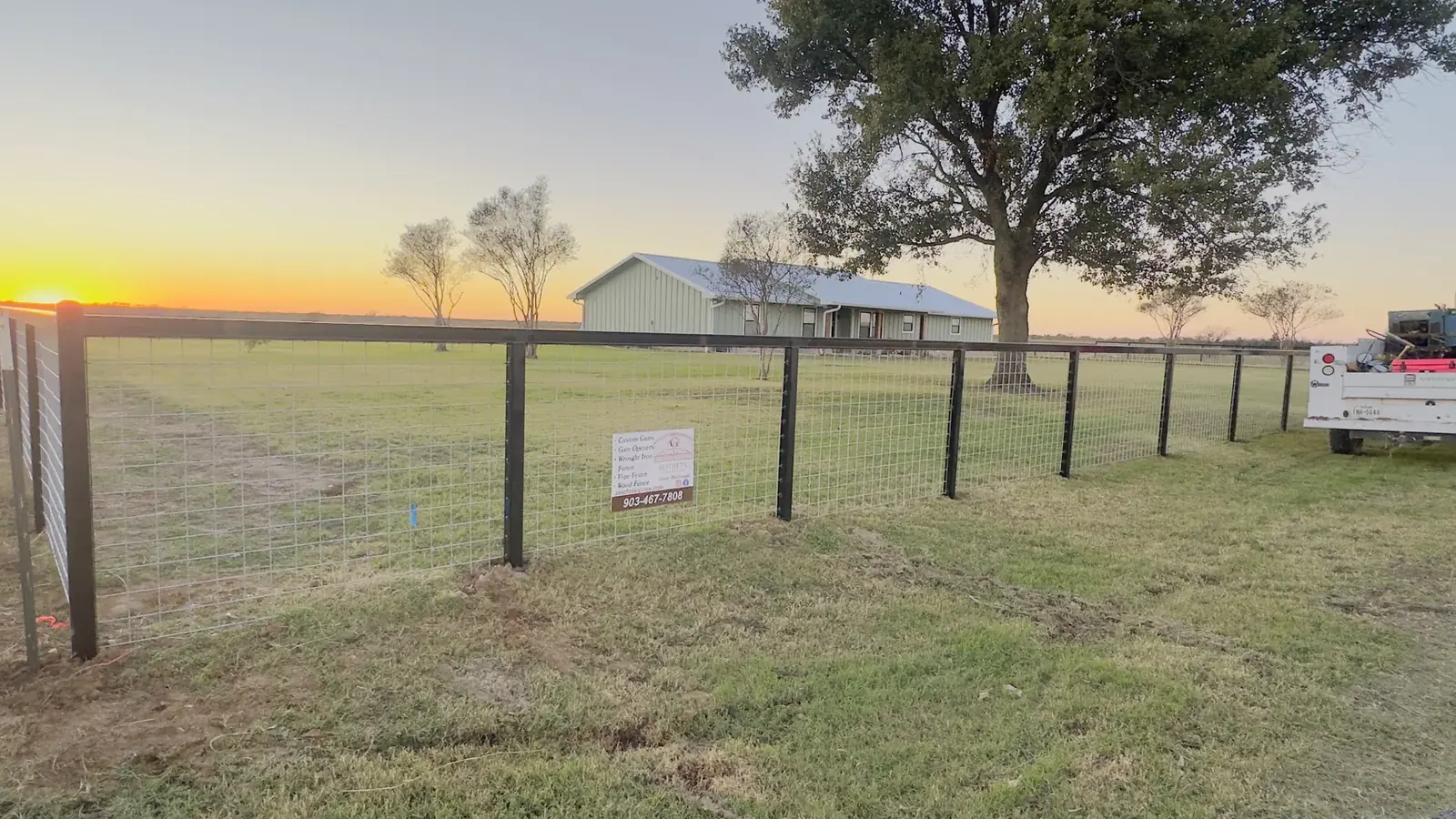
Open rail holds cattle and horses but not goats, sheep, dogs or calves. Adding woven field wire or no-climb mesh to the pipe frame is a second material and a second labor pass. National surveys put installed woven wire alone at about $1.50–$5.90 per linear foot, which is a reasonable floor for what wire adds on top of the pipe.
4. Posts, spacing and concrete
Posts are where pipe fence succeeds or fails, especially in Blackland clay. Tighter spacing means more posts, more holes and more concrete. At 8-foot centers a 1,000-foot run needs about 125 line posts; at 10-foot centers, about 100. Depth and footing size add cost per hole but are what keep the line straight after a wet winter and a dry August.
5. Corners, braces and gates
Corners and gate openings need heavier posts and braces, so a line with many angles costs more per foot than a straight one. Gates are priced separately: about $160–$800 for a livestock gate in national surveys, and far more for a welded ranch entrance.
Pipe fence cost breakdown by component
Materials are most of a pipe fence bill. National surveys put pipe fence materials at about $11.50–$34 per linear foot and contractor labor at about $2–$6 per linear foot on top, so labor is usually the smaller share. The table pulls the main components together.
| Component | Typical range | Notes |
|---|---|---|
| Pipe fence, installed | $13.50–$40 per linear ft | Materials and labor; rural Texas benchmark about $13.50/ft |
| Pipe fence materials only | $11.50–$34 per linear ft | Pipe, posts, caps, concrete |
| Installation labor | $2–$6 per linear ft | About $1,700–$5,100 for a one-acre perimeter |
| Woven field wire added | $1.50–$5.90 per linear ft | Installed woven wire on its own; no-climb mesh at the higher end |
| Painting a metal or wire fence | $2–$7 per linear ft | Higher if the pipe needs cleaning and priming first |
| Metal post, installed | $50–$210 each | Line and corner posts vary widely |
| Livestock gate | $160–$800 each | 6-ft walk gate up to a 16-ft drive-through |
| Driveway gate, installed | $1,000–$6,000 | National average; custom ranch entrances run higher |
| Land clearing | $1,300–$5,700 per job | Brush and trees along the fence line |
Pipe vs. pipe-and-wire vs. wood rail vs. wire fence
Pipe and wood rail cost about the same per foot in published surveys, and barbed or net wire on steel posts costs a fraction of either. The right choice depends on what the fence has to hold and how long you want it to last.
| Option | Typical installed cost | Best for |
|---|---|---|
| Open pipe rail (2–4 rail) | $13.50–$40 per ft | Cattle, horses, road frontage, long life |
| Pipe frame with woven or no-climb wire | Pipe cost plus roughly $1.50–$5.90 per ft | Goats, sheep, dogs, calves, foals |
| Wood split-rail ranch fence | $15–$35 per ft | The traditional look near the house |
| Wood split rail with wire mesh | $35–$40 per ft | Wood look that still holds small animals |
| 4–6 strand barbed wire, steel posts | About $18,600 per mile (≈$3.50 per ft) Texas average | Back pasture lines on large acreage |
| Net wire | About $21,100 per mile (≈$4 per ft) Texas average | Sheep and goat pasture |
2-rail, 3-rail and 4-rail pipe
Two-rail pipe is mostly a boundary and frontage fence; three-rail is the common choice for cattle and horses; four-rail is for tighter containment or a heavier look at the entrance. No neutral survey publishes a clean price for each rail count on pipe, so use the rail math: a 3-rail fence carries 50% more rail pipe than a 2-rail, and a 4-rail carries double. For comparison, a national survey of wood rail fence puts 2-rail at $15–$20, 3-rail at $20–$25 and 4-rail at $25–$30 per foot, about $5 a foot for each added rail.
Pipe with field wire (no-climb)
Adding wire to a pipe frame is the answer when the stock is small enough to walk between rails. Woven field wire is the cheaper mesh; no-climb horse wire has a tighter weave that hooves cannot catch in and costs more. Either way, the wire is a second material and second labor pass on top of the pipe price.
Wood rail ranch fence
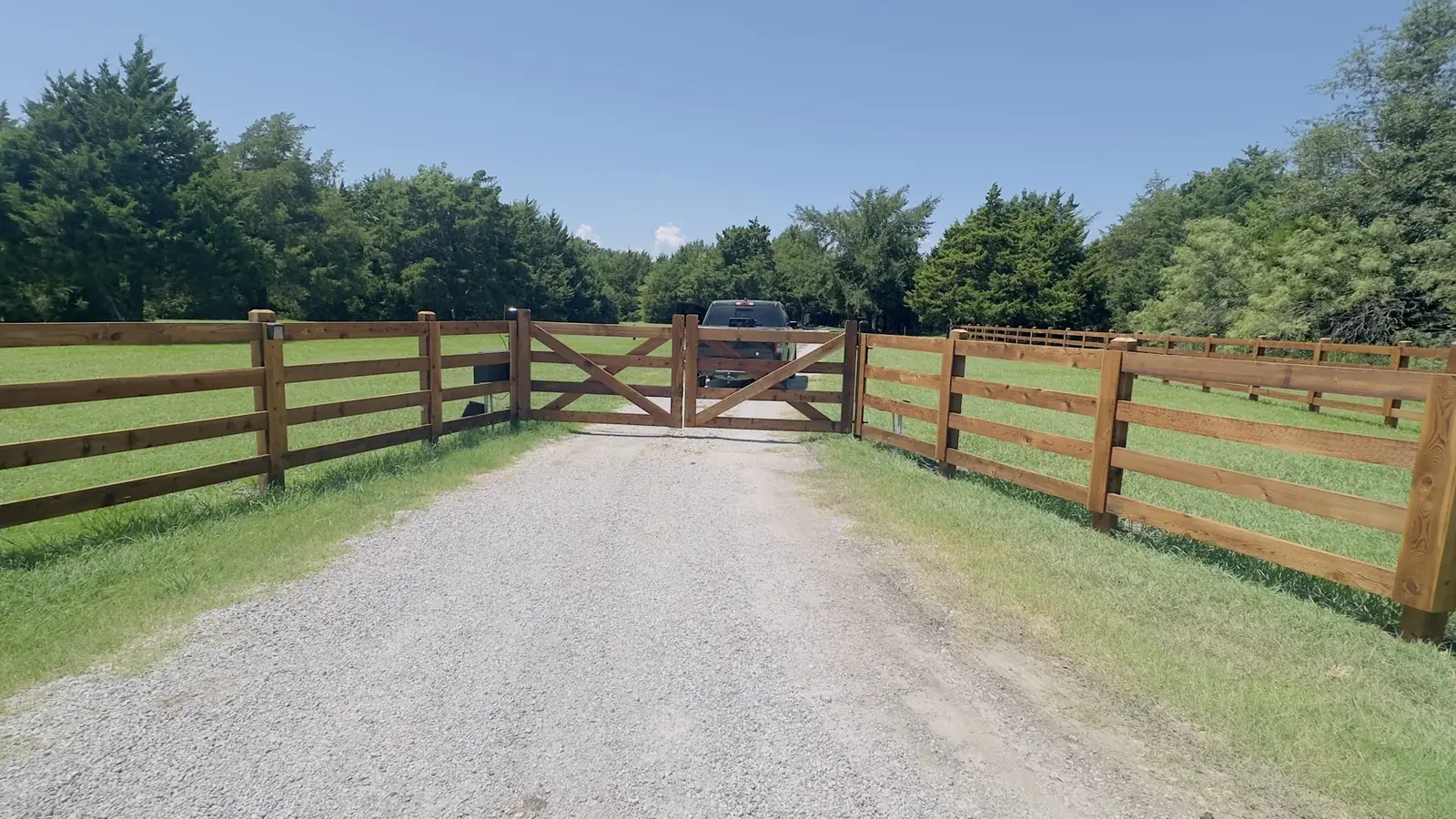
Wood split-rail runs about $15–$35 per linear foot installed in a national survey: pine at $15–$25 and cedar at $25–$35. It reads softer around a house, but wood sits in the ground, and the ground line is where it rots. Pipe does not have that problem.
Barbed or net wire for the back lines
Texas A&M AgriLife's 2026 custom-rate survey puts 4–6 strand wire on steel posts at about $18,600 per mile on average statewide, and net wire at about $21,100 per mile. That is roughly $3.50–$4 a foot, which is why many places run pipe across the front and wire along the back pasture.
Pipe fence cost by acreage: the perimeter math
To price a perimeter, find the feet of fence, then multiply by the per-foot rate. An acre is 43,560 square feet. A perfectly square tract has the shortest perimeter for its area: take the square root of the area to get one side, and multiply by four. Real tracts are rarely square, so treat these as the minimum footage.
| Tract | Perimeter (square tract) | Estimated installed cost |
|---|---|---|
| Road frontage only (300–600 ft) | 300–600 ft | $4,050–$24,000 |
| 1 acre | ≈ 209 ft × 4 = 835 ft | $11,300–$33,400 |
| 5 acres | ≈ 467 ft × 4 = 1,867 ft | $25,200–$74,700 |
| 10 acres | 660 ft × 4 = 2,640 ft | $35,600–$105,600 |
| 20 acres | ≈ 933 ft × 4 = 3,734 ft | $50,400–$149,400 |
Front acreage: road frontage only
Fencing only the road side is the most common first project on acreage, and the cheapest. A 300-foot frontage at $13.50–$40 a foot comes to about $4,050–$12,000; a 600-foot frontage about $8,100–$24,000, before the entrance gate.
5 acres
A square 5-acre tract is about 467 feet on a side, so roughly 1,867 feet of fence, or about $25,200–$74,700 in pipe. A 5-acre lot shaped 330 by 660 feet needs 1,980 feet, about 6% more, which is why long, narrow tracts cost more to close in.
10 acres
A square 10-acre tract is 660 feet on a side, or 2,640 feet of fence, about $35,600–$105,600 in pipe at the published range. In wood split-rail, a national survey puts a 10-acre boundary at about $25,000–$35,000.
20 acres
A square 20-acre tract is about 933 feet on a side, or roughly 3,734 feet, which works out to about $50,400–$149,400 in pipe. At this size many owners price pipe across the front and wire on the other three sides, since 4–6 strand wire runs about $3.50 a foot on Texas averages.
Local factors in Corsicana, Ennis and Waxahachie
Navarro and Ellis County ground is the biggest local cost factor: Blackland Prairie clay swells when wet and shrinks when dry, and it pushes shallow posts out of line. Deeper holes and proper concrete cost more per post and are the reason the fence is still straight in a few years.
- Clay heave: posts set too shallow in Blackland clay lean and lift. Expect depth and footing size to show up in the quote.
- Wind and storms: long open runs and tall entrances take wind load, so corner bracing and post size matter more here than on a sheltered lot.
- Acreage and access: brush, creek crossings and tree lines along an old fence row add clearing cost before the first post goes in.
- Property lines: on rural tracts, old fence lines are often not on the true line. A survey costs about $200–$1,200 nationally and is cheaper than moving a fence.
- Call Texas811 before digging: it is free, and every post hole is a dig. Rural lines and pipelines are common in the county.
Aesthetic Gates builds pipe and ranch rail fence across Corsicana, Kerens, Mexia and the rest of the service area, and welds ranch entrances and gates in its own shop.
Ag valuation is not a fence subsidy
Texas agricultural appraisal does not pay for a fence. The Texas Comptroller describes it as a way of valuing qualifying land by its capacity to produce, rather than market value, for property tax; it is not a grant, rebate or fencing program.
Separately, the Comptroller lists fencing materials and gates used to contain agricultural livestock among items a qualifying producer can buy without sales tax, using a registered Ag/Timber Number and an exemption certificate. Whether that applies depends on your operation, so check with the Comptroller or your tax adviser rather than counting it in the budget. Do not plan a fence around a saving you have not confirmed.
Mistakes that cost acreage owners money
Most expensive fence mistakes happen before the first post is set: choosing on price alone, guessing the length, and skipping the wire decision.
1. Hiring on price alone
The cheapest quote usually saves on post depth, concrete, pipe wall thickness or paint, none of which you can see on day one. A pipe fence that leans in Blackland clay costs more to straighten than it saved.
2. Guessing the footage
A rectangle has more perimeter than a square of the same acreage, and old fence lines wander. Measure or survey the real line before comparing per-foot prices.
3. Building open rail for small stock
Goats, calves and dogs walk through open rail. Adding wire after the fence is up costs more than building it in, so decide what the fence has to hold first.
4. Skipping paint
Unpainted pipe rusts, and painting an old rusted fence means scraping and priming first. Painting at install is cheaper and protects the investment.
5. Treating ag valuation as fence money
Ag valuation lowers how land is appraised for property tax; it does not reimburse a fence. Budget the full cost.
How to compare pipe fence quotes
Compare pipe fence quotes line by line, not by the bottom number. Two quotes at the same total can describe very different fences.
A real quote should spell out:
- Total linear feet and where the line runs.
- Pipe size and wall thickness for posts and rails, and the number of rails.
- Post spacing, hole depth and concrete per post.
- Corner and brace construction.
- Wire type and height, if any.
- Paint: included or not, and what prep.
- Gates and the entrance as separate line items.
- Clearing, old fence removal and cleanup.
- Who calls Texas811 and who confirms the property line.
Aesthetic Gates quotes each job after seeing it, with a free written estimate. See finished fences and entrances on our work page, or request an estimate. If the fence needs a matching entrance, gates are built for Corsicana, Waxahachie and Ennis properties too.
FAQs
THE SERVICE
Pipe & Ranch Rail Fence from Aesthetic Gates
Welded pipe fence and wood rail fence for acreage, pastures and ranch perimeters.
Sources
- Angi — How Much Does a Pipe Fence Cost? — national averages, updated Oct 2025: $13.50–$40/ft installed, $11.50–$34/ft materials, $2–$6/ft labor, Amarillo TX $13.50/ft, 835 ft per square acre, $160–$800 livestock gates, $1,300–$5,700 clearing
- HomeAdvisor — How Much Does a Pipe Fence Cost? — national averages, 2025; confirms $13.50–$40/ft and $11,300–$33,400 per square acre
- HomeGuide — How Much Does a Split Rail Fence Cost? — national averages: $15–$35/ft, by rail count, with mesh $35–$40/ft, per-acre totals, removal $7–$20/ft, survey $200–$1,200
- Fixr — Wire Fence Installation Cost — national averages: woven wire $1.50–$5.90/ft installed, painting $2–$7/ft
- Fixr — Cost to Install Fence — national averages: metal posts $50–$210 installed, driveway gate $1,000–$6,000
- Texas A&M AgriLife Extension — 2026 Texas Agricultural Custom Rates — statewide averages: 4–6 wire with steel posts $18,633/mile; net wire $21,150/mile
- Texas Comptroller — Agricultural and Timber Exemptions — sales tax exemption for qualifying producers; lists fencing materials and gates used to contain livestock
- Texas Comptroller — Agricultural and Timberland Appraisal — ag appraisal is a property tax valuation method, not a payment
More cost guides
CORSICANA, TEXAS — 32.0954° N, 96.4689° W
GET YOUR OWN NUMBER.
Averages only go so far. Send a few photos and the address, and Cesar will come look at it and give you a straight number — free.