2026 PRICING GUIDE
Cedar vs Pressure-Treated Pine Fence in Texas: Which Lasts Longer? (2026)
By Aesthetic Gates & Fence · Updated · 12 min read
Quick answer
Cedar usually lasts longer. Titan Fence, a North DFW contractor, puts cedar at about 15–25 years in Texas and pressure-treated pine at about 10–15 years, and Fixr’s national figures land in the same place. But the wood above ground matters less than the posts: a post rated for ground contact, or a galvanized steel post, is what keeps a fence standing in Ellis and Navarro County clay.
- Lifespan: cedar about 15–25 years, pressure-treated pine about 10–15, untreated pine about 8–12 (Titan Fence, Texas, Nov 2025). These are contractor and cost-guide figures, not field tests.
- Rot: only cedar heartwood resists decay; the pale sapwood of almost any species rots quickly, says the USDA Forest Products Laboratory.
- Termites: Texas A&M AgriLife says subterranean termites are found throughout Texas. Neither cedar nor pine is termite-proof.
- Ground contact: posts need treated lumber tagged UC4A or higher; pickets need UC3B or higher, per the American Wood Protection Association.
- City rules: Midlothian prohibits pine pickets and requires galvanized steel posts; Waxahachie requires metal posts on privacy fences.
- Cost: about $26–$32 per foot for 6 ft cedar and $24–$29 for pressure-treated pine, installed, in Titan Fence’s North Texas survey.
For a fence you plan to keep, cedar pickets on ground-contact treated posts or galvanized steel posts is the build the sources point to. Every price on this page is a third-party figure. Aesthetic Gates & Fence has not published prices; Cesar quotes each fence after seeing it, with a free written estimate.
These are published area averages from the sources listed at the end of this guide, not an Aesthetic Gates price list. Cesar quotes every job after seeing it, and the estimate is free.
Cedar vs pressure-treated pine fence lifespan in Texas
Cedar pickets usually outlast pressure-treated pine pickets in published figures, but on either fence the posts tend to fail first. Titan Fence, a North DFW contractor, says cedar lasts 15–25 years in Texas climates and pressure-treated pine 10–15 years (November 2025).
Other sources agree on the order, if not the exact years. Fixr’s national comparison gives pine 10–15 years and well-kept cedar 20–25 years. DFW Fence Contractor, a Fort Worth company, says a cedar fence can last 15+ years with staining and pine 8–12 years (October 2025).
| Source | Cedar | Pine | Area and date |
|---|---|---|---|
| Titan Fence | 15–25 years | 10–15 years treated; 8–12 untreated | Texas, Nov 2025 |
| DFW Fence Contractor | 15+ years with staining | 8–12 years | DFW, Oct 2025 |
| Fixr, cedar vs pine | 20–25 years, maintained | 10–15 years | National, undated |
| Fixr, wood fence cost | About 20 years for a well-built wood fence with routine maintenance | 10–15 years pressure-treated | National, Jan 2025 |
Titan adds a condition to its cedar number: 15–25 years in North Texas "if properly sealed and maintained." Johnson Fence, a Tomball contractor, argues that the common national answer of "10 to 20 years" ignores local conditions, and that cedar heartwood beats pine above ground while treated pine beats cedar in the ground.
Why cedar resists rot, and why some cedar does not
Cedar’s rot resistance lives in the heartwood, the darker center of the log. The USDA Forest Products Laboratory’s Wood Handbook (2021) says untreated sapwood of essentially all species has low decay resistance, so pale cedar sapwood is not much better than untreated pine.
The same handbook says "resistant" heartwood generally serves well above ground, but only "very resistant" heartwood holds up in ground contact, and in severe decay conditions it recommends pressure-treated wood rather than resistant heartwood. It also warns that many species sold today are second growth with a high share of sapwood.
The Wood Database rates western red cedar as durable to very durable for decay, and loblolly pine heartwood (a southern yellow pine) as moderate to low, and notes loblolly is usually pressure-treated for outdoor use. The Western Red Cedar Lumber Association, an industry group, credits natural compounds called thujaplicins with acting as built-in preservatives.
Ask what grade and how much heartwood
Johnson Fence points out that "cedar" names a species, not a grade. Pickets are graded #1 to #3, and the share of heartwood depends on the grade. When you compare quotes, ask what grade of picket is in the bid and how much of each board is heartwood.
How the Texas climate changes the answer
Decay needs warmth and moisture, and North Texas has less of both than the Gulf Coast. On the Scheffer decay-hazard index, recalculated from 1971–2000 weather data by FPInnovations researchers Wang and Morris (2008), Dallas-Love Field scores 44, in the moderate band, while Houston scores 77, in the high band.
| Station | Index | Band |
|---|---|---|
| Dallas-Love Field | 44 | Moderate |
| San Antonio | 52 | Moderate |
| Austin | 55 | Moderate |
| Houston Airport | 77 | High |
| Port Arthur | 81 | High |
No index has been published for Corsicana, Waxahachie or Ellis County; Dallas is the nearest station listed. That matters when you read fence advice online, because a lot of Texas fence content is written for Houston, where rot pressure is much higher.
The overall climate is only part of it. Fine Homebuilding calls cedar "rot resistant, not rotproof" and notes that rot on a post starts where the concrete stops and the soil meets the wood, and that water wicks up cut end grain far more readily than through the sides of a board. The wet zone at the bottom of the fence is where trouble starts, here or anywhere.
Do termites eat cedar or pine fences in Texas?
Neither wood is termite-proof. Texas A&M AgriLife Extension says subterranean termites are found throughout the state, cause about $500 million in damage in Texas each year, and need moisture and contact with soil.
AgriLife’s guide is about protecting houses, not fences, but it names fences directly. It tells homeowners to check any earth-to-wood contact such as fences, to remove wood-to-soil contact where fence posts are attached to the house, and says wood that touches soil should be pressure treated.
The USDA Wood Handbook’s short list of U.S. woods with natural termite resistance names redwood heartwood and very resinous southern pine heartwood, which is rarely available. Cedar is not on that list. That does not mean cedar attracts termites; it means no common fence wood can be counted on to stop them.
Steel posts take the wood out of the ground entirely. Master Halco, which makes galvanized steel fence posts, says its steel post will not rot, twist or warp and does not suffer termite damage. That is the maker’s claim.
Ground contact: how to read the tag on treated lumber
Look at the end tag. The American Wood Protection Association says fence pickets need Use Category UC3B or higher (above ground, exposed) and posts in the ground need UC4A or higher (ground contact). A post rated only for above-ground use is not made to sit in soil.
AWPA’s 2025 U1 standard lists "sawn fence posts" as an example of UC4A, general ground contact. UC4A also covers some wood above ground, such as parts that get wet again and again, sit less than 6 inches above grade on concrete or treated wood with no moisture barrier, or are hard to replace and critical to the structure. UC4B is the heavy-duty ground-contact category for severe sites, climates with high decay potential and critically important parts such as building poles.
What is printed on the tag
- Exposure: for example "ABOVE GROUND" or "GROUND CONTACT".
- Standard and category: for example "AWPA U1, UC3B".
- Preservative and retention: the chemical and how much is in the wood.
- Inspection agency logo and treating company.
Johnson Fence recommends ground-contact treated pine for posts and cedar for pickets, because a cedar post carries no preservative rated for burial. Fixr says the same in plain terms: pine is better for posts, and many fences use pine posts with cedar panels.
Why treated pine shrinks and warps more than cedar
Pressure treatment soaks pine with water-based preservative, so it shrinks as it dries out on your fence line, and pine moves more than cedar to begin with. An LSU AgCenter publication co-written by a USDA Forest Products Laboratory scientist explains that wood only shrinks below about 30% moisture, and waterborne treatment pushes it above that point.
The Wood Database lists green to oven-dry shrinkage of 5.0% tangential and 6.8% volumetric for western red cedar, against 7.4% tangential and 12.3% volumetric for loblolly pine. These are lab figures for wood dried all the way out, not what a fence board does in one summer, but they show which wood moves more.
Fixr rates cedar low risk for warping and shrinking and pine more at risk. The Western Red Cedar Lumber Association says its wood is less likely to swell, warp, cup and twist than other woods (an industry claim).
If you go with pine, the LSU guide says lumber marked KDAT (kiln dried after treatment) is the choice where stability matters. Johnson Fence also advises letting new treated pine go through a Texas summer, and doing a water test, before staining, because it arrives wet from the mill.
Wood posts or galvanized steel posts in Blackland clay
Posts are the weak point in this soil. The USDA soil survey’s Ellis series, named in Ellis County in 1910 with its type location in Navarro County, is 40–60% clay with high shrink-swell potential and cracks 0.5 to 3 inches wide. Houston Black clay, found across the Blackland Prairies, cracks 0.5 to 4 inches wide when dry.
Johnson Fence describes what that does to a fence: clay swells in a wet spring and shrinks in a dry August, and that pushes shallow posts out of line. Titan Fence says expansive North Texas clay calls for deeper post settings, typically 30–36 inches.
Treated pine posts
A UC4A treated pine post set in concrete is the standard wood option. The weak spot is at the soil line: Fine Homebuilding notes rot starts where the concrete stops and the soil meets the wood, and recommends pouring concrete even with finish grade. Fixr puts a wood post at $10–$50 installed, national.
Galvanized steel posts
Steel posts cost more up front and take rot and termites out of the picture. Fixr puts a metal post at $10–$60 installed, national. Fence Advisors, a contractor directory, says metal posts with wood panels add about $5–$10 per foot and can potentially double a fence’s life. Titan Fence says steel posts cost more but improve lifespan over wood posts.
Master Halco describes its post as ASTM A653 steel with a G90 galvanized coating, engineered for a 70 mph wind load on a 6 ft privacy fence with posts every 8 feet. No independent study of steel post life in Blackland clay was found, so no one can honestly give you a number of years.
If your current fence is leaning, the posts are the first thing to check. See fence repair for what that involves.
What cedar and pine cost per foot in North Texas
Cedar costs more per foot than pressure-treated pine in every survey below. Titan Fence’s North Texas survey puts 6 ft cedar at $26–$32 per foot installed and pressure-treated pine at $24–$29, with materials alone at $8–$12 for cedar and $4–$7 for pine.
| Source and area | Cedar | Pressure-treated pine |
|---|---|---|
| Titan Fence, North Texas, Nov 2025 | $26–$32 | $24–$29 |
| Titan Fence, Texas, materials only | $8–$12 | $4–$7 |
| Fence Advisors, Texas, Mar 2026 | $25–$55 | $18–$35 |
| DFW Fence Contractor, DFW, Oct 2025 | $30–$60 (mid-range cedar) | $15–$30 (budget) |
| Fixr, national, undated | $20–$35 | $10–$20 |
Fence Advisors puts standard cedar privacy fence in DFW at $28–$45 per foot and cedar with metal posts at $38–$55 (March 2026). For lengths, styles, gates and extras, see our Corsicana privacy fence cost guide and what a cedar fence on metal posts costs in Waxahachie.
Western red cedar vs Japanese cedar pickets
They are different trees with different ratings. The Wood Database rates western red cedar (Thuja plicata) durable to very durable for decay and Japanese cedar, also called sugi (Cryptomeria japonica), moderately durable to durable. They are not even in the same genus.
Top Rail Fence, an Irving contractor serving North Dallas, claims Japanese cedar lasts 7–15 years in North Texas and costs 10–15% less than western red cedar. That is one contractor’s unsourced claim, so weigh it accordingly.
The simple fix is to ask. Have the species and the picket grade written on the quote, so you know what you are comparing.
How often to stain a cedar or pine fence in Texas
Plan on staining every few years, and more often for pine. Titan Fence says to stain a wood fence every 2 to 3 years; Johnson Fence says to coat a DFW fence every 3 to 4 years and walk the line each spring; DFW Fence Contractor says every 2–4 years.
Fence Advisors says pine needs staining every 1–2 years and puts stain on a new fence at about $1.50–$3.00 per foot (March 2026). New treated pine should dry first, as covered above.
Stain is for the boards above ground. Johnson Fence’s staining guide notes that posts are specified for ground contact, and that stain’s job is shedding water off the boards. See fence staining and sealing if your fence is due.
Midlothian and Waxahachie rules that pick the wood for you
Inside Midlothian city limits, pine pickets are not allowed and posts must be galvanized steel. Inside Waxahachie city limits, privacy fences must stand on metal posts. These rules come from each city’s zoning ordinance and apply only inside city limits.
Midlothian, Zoning Ordinance §3.5221
- Pickets: "Pine pickets and planks (treated or untreated) are prohibited." Pickets must be at least 5/8 inch thick, of spruce or a naturally rot-resistant wood such as cedar, cypress or redwood.
- Posts: 2-3/8 inch outside diameter, 0.095 (Schedule 20) galvanized steel with a galvanized cap.
- Setting (5–7 ft fences): posts no more than 8 feet apart, embedded at least 24 inches in a 30 inch deep, 6 inch concrete footing.
- Off the ground: the fence bottom may not touch the ground, with no more than a 4 inch gap.
In Midlothian the choice is already made: cedar (or another allowed wood) on galvanized steel posts. See privacy fence in Midlothian.
Waxahachie, Zoning Ordinance Sec. 5.03
- Posts: at least 13-gauge metal posts no more than 8 feet apart, or 15-gauge no more than 6 feet apart, with metal caps and metal brackets.
- Rails: at least 2x4, cedar, pressure-treated or chemically treated.
- Pickets: finished wood; cedar is acceptable. Townhome rear-yard fences must use pressure-treated or chemically treated pickets.
- Materials: all fence materials must be new and made for fencing, per the city’s Fence Permit Submittal Guide.
So in Waxahachie you can still choose cedar or treated pickets, but the posts are metal either way. See privacy fence in Waxahachie and wood fence in Waxahachie. For permits, heights and the rules in Ennis and Red Oak, read fence permit rules in Waxahachie, Ennis, Midlothian and Red Oak.
So which should you pick?
For a 6 ft privacy fence you plan to keep, cedar pickets on ground-contact treated posts or galvanized steel posts is the combination the sources point to. Pressure-treated pine is the budget choice where your city allows it, with a shorter expected life and more staining.
- Pick cedar if you want the longer published lifespan, less warping and you live in Midlothian, where pine pickets are not allowed.
- Pick treated pine if the budget is tight, you are outside Midlothian, and you are fine staining more often.
- Either way, check the post: UC4A or higher on wood, or galvanized steel, set deep in concrete.
Aesthetic Gates & Fence builds wood privacy fence across Navarro and Ellis County, including privacy fence in Ennis, privacy fence in Corsicana and fence and gate work in Waxahachie. See finished fences, read our Google reviews, or ask for a free written estimate. Cesar will look at the property and quote the fence in writing.
FAQs
THE SERVICE
Privacy Fence from Aesthetic Gates
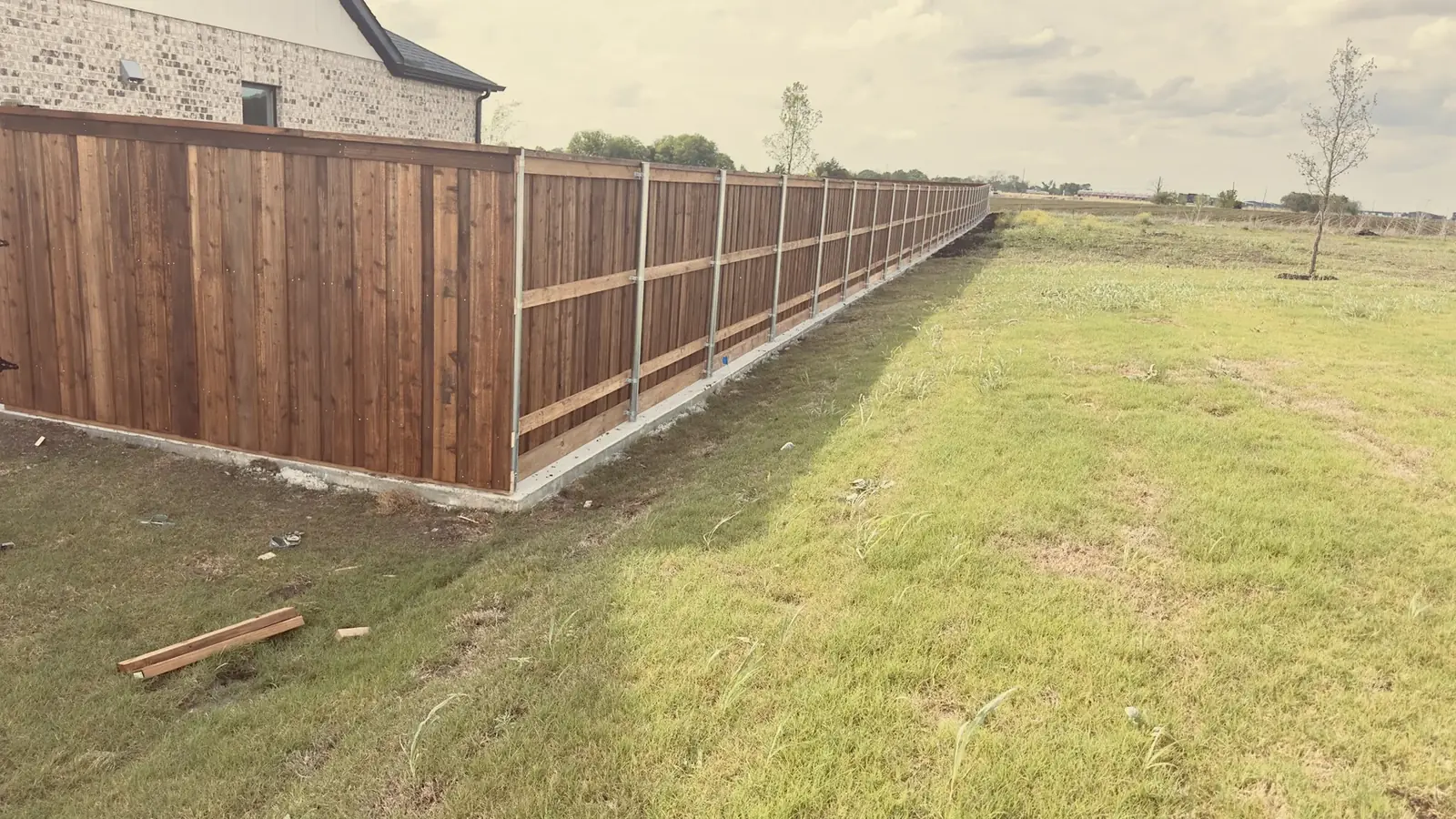
Cedar and wood privacy fence built on posts set in concrete, with the pickets and rails matched to what is already on the property.
Sources
- Titan Fence: Wood Fence Cost: North DFW contractor, Nov 28, 2025; North Texas prices, materials, Texas lifespans, post depth, staining, steel posts
- Fence Advisors: Fence Cost in Texas 2026: contractor directory, Mar 22, 2026; Texas and DFW prices, metal posts, pine staining
- DFW Fence Contractor: 6 Foot Privacy Fence Cost in Dallas Fort Worth: Fort Worth contractor, Oct 22, 2025; DFW prices, lifespans, staining
- Fixr: Cedar vs Pine Fence: national, undated; prices, lifespans, warping, pine posts with cedar panels
- Fixr: Wood Fence Cost: national, updated Jan 31, 2025; lifespans, wood vs metal post cost
- Johnson Fence: Cedar or Pressure-Treated Pine for a Texas Fence: Tomball TX contractor, Aug 14, 2026 (updated Oct 6, 2026); posts vs pickets, picket grades
- Johnson Fence: How Long a Wood Fence Actually Lasts in Texas: Aug 31, 2026; national 10 to 20 year answer, heartwood vs treated pine
- Johnson Fence: How Often a Texas Wood Fence Needs Staining: Aug 14, 2026; DFW staining interval, waiting on new treated pine
- Johnson Fence: How Deep a Fence Post Goes in Texas Soil: 2026; clay movement and post setting
- Wang and Morris (FPInnovations): Scheffer Climate Index: Canadian Wood Preservation Association Proceedings, 2008; decay index for Dallas, Houston, Austin, San Antonio, Port Arthur
- USDA Forest Products Laboratory: Wood Handbook, Ch. 14 Biodeterioration of Wood: FPL-GTR-282, 2021; heartwood vs sapwood, ground contact, termite-resistant woods
- LSU AgCenter Pub. 2703: Causes and Control of Wood Decay, Degradation & Stain: Shupe, Lebow (USDA FPL), Ring; rev. 2008; fiber saturation, shrinkage of treated lumber, KDAT
- The Wood Database: Western Red Cedar: decay rating and shrinkage figures
- The Wood Database: Loblolly Pine: decay rating and shrinkage figures
- The Wood Database: Sugi (Japanese cedar): decay rating
- Western Red Cedar Lumber Association (Real Cedar): industry group; thujaplicins, warping claim
- Top Rail Fence: Top Wood Fence Types for North Dallas: Irving TX contractor, Sep 9, 2025; Japanese cedar lifespan and price claim (unsourced)
- Fine Homebuilding: Preventing Fence-Post Rot: Q&A by Eric Nelson, Issue 162, May 2004; where post rot starts
- Fine Homebuilding: Preventing Cedar-Post Rot: Mike Guertin, Issue 260, Jun/Jul 2016; end grain and delaying rot
- AWPA U1-25 Use Category excerpt: American Wood Protection Association, 2025; UC3B, UC4A, UC4B
- AWPA Residential Infographic: 2021; pickets UC3B, posts UC4A, reading the end tag
- Texas A&M AgriLife Extension E-368: Subterranean Termites: Gold, Schofield, Brown, Keck, 2010; statewide range, Texas damage, wood-to-soil contact
- Master Halco PostMaster steel post spec (via Sweets): manufacturer claims: G90 galvanized, no rot or termite damage, 70 mph wind load
- USDA NRCS: Ellis Soil Series: rev. 03/2001; clay content, shrink-swell, crack width
- USDA NRCS: Houston Black Soil Series: rev. 08/2017; clay content, shrink-swell, crack width
- City of Midlothian Zoning Ordinance, Chapter 3 (via Zoneomics): §3.5201 and §3.5221 wood fence material and post standards
- City of Waxahachie Zoning Ordinance, Chapter 5 (via Zoneomics): Sec. 5.03 fence posts, rails and pickets
- City of Waxahachie: Fence Permit Submittal Guide: rev. 05/24; metal post rule, new materials
More cost guides
- How Much Does a Welded Steel Patio Cover Cost in Ellis County, Texas? (2026)
- How Much Does Fence Repair Cost in Waxahachie and Ellis County? (2026)
- Gate Opener Not Working? Repair or Replace in Waxahachie (2026)
- How Much Does a Custom Driveway Gate Cost in Red Oak, TX? Styles and Prices (2026)
- Privacy Fence Installation Cost per Linear Foot in Midlothian, TX (2026)
- Best Solar Gate Openers for Heavy Ranch Gates in Texas: Solar or Wired? (2026)
- Are Steel Fence Posts Better Than Wood in Texas Clay? (2026)
- Best Fence and Gate Companies in Ellis County, TX (2026)
- How Much Does a Ranch Entrance with a Pipe Gate Cost in Navarro County, Texas? (2026)
- Do You Need a Fence Permit in Waxahachie, TX? Permit Requirements and Fence Height Rules for Ellis County (2026)
- Wood Privacy Fence Installation Cost per Linear Foot in Waxahachie, TX (2026)
- How Much Does Automatic Driveway Gate Installation Cost in Midlothian and Ellis County, TX? (2026)
- How Much Does a Welded Metal Carport Cost in Ellis and Navarro County, TX? (2026)
- How Much Does a Driveway Gate Cost in Corsicana, TX? (2026)
- How Much Does an Automatic Gate Opener Cost in Corsicana, TX? (2026)
- How Much Does a Privacy Fence Cost in Corsicana, TX? (2026)
- How Much Does a Wrought Iron Fence Cost in Corsicana, TX? (2026)
- How Much Does Pipe Fence Cost in Texas? (2026): Pipe & Ranch Rail Fence Pricing for Navarro County
CORSICANA, TEXAS · 32.0954° N, 96.4689° W
GET YOUR OWN NUMBER.
Averages only go so far. Send a few photos and the address, and Cesar will come look at it and give you a straight number, free.